Blog
How to Explain Water Saving to Your Customer and Close the Quote
25 August 2026
A quote that stalls rarely comes down to the price itself: more often, the customer does not understand the reasons for water saving and why they should spend more on a rain sensor or an internet connection for the system. Translating these technical features into a concrete outcome — less water, fewer call-outs, a healthier lawn — is what makes the difference between an accepted quote and one left pending.
The problem is not the price, it’s the translation
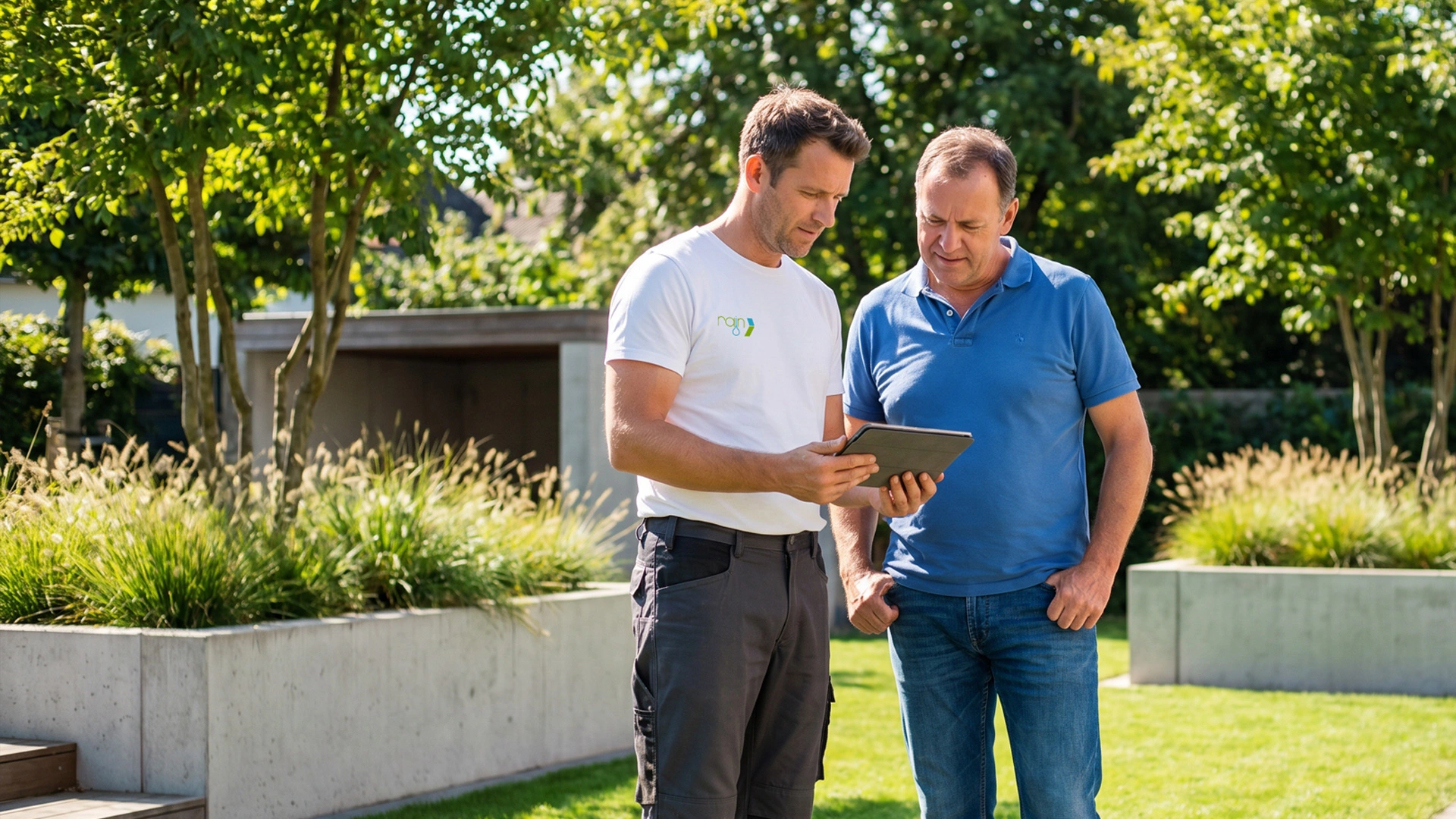
When presenting a system with an Acqua Vision rain sensor or with Nuvola WiFi Vision connectivity, the customer hears about Bluetooth, apps, sensors — terms that tell them nothing about why they should choose that configuration over a cheaper one. The installer’s job is to bridge this gap: explain the water saving outcome first, before the technical feature, not the other way around.
Arguments by customer type
Cost-conscious customer
The simplest figure to use is economic: by stopping irrigation during and after rain, waterlogging is avoided and consumption can be reduced by up to 20%. With this customer, it is best to lead with the number, not the device: “with a rain sensor, you save on average a fifth of the water the system would otherwise use in a season.”
Customer who travels frequently or has a second home
Here the argument is not savings but control and peace of mind: with a Nuvola WiFi Vision or Nuvola Cell Vision device, the customer can manage their irrigation from the office or on holiday, monitoring the system from their smartphone via the Vision App. For a customer with a second home, this means not having to ask a neighbour to check whether it has rained or whether the irrigation cycle has started — they can see it independently on the app.
Sceptical customer who questions the additional cost
This is the customer who says “a standard timer is enough for me.” The effective argument here is the comparison between reactive intervention and avoided intervention: a Nuvola device capable of synchronising daily with local weather stations blocks a scheduled irrigation cycle when rain is forecast. This is not just about saving water when it rains, but about preventing in advance a cycle that would have been unnecessary. The practical message: “the smart system does not add functions — it prevents waste you simply cannot control with a standard timer.”
Customer focused on garden/lawn health
With this profile, the technical argument works better when linked to a problem the customer already recognises: a lawn irrigated “blindly” — even when it rains or is already saturated — is more prone to waterlogging and stress. The rain sensor, beyond the saving, protects the quality of the planting scheme by avoiding unnecessary cycles at the wrong moments.
How to present water saving in the quote
A practical tip to prevent the sensor-and-connectivity configuration from being perceived as a vague “extra”: propose two separate line items, not a single total.
- Line 1 — Basic system: controller + solenoid valves, fixed-timer programming.
- Line 2 — Full configuration: addition of Acqua Vision and a Nuvola device, with a sentence summarising the benefit (not the technical specification): “a system that stops automatically when it rains and that you can control from your phone.”
In this way, the customer immediately sees what changes in terms of outcome — water saving — not just price. If the quote stalls after the first presentation, often a targeted phone call focusing on just one of these two arguments (economic saving or remote control), chosen based on which seemed to interest the customer most during the site visit, is enough to get the decision moving.
Discover the latest innovations
in irrigation systems!