Blog
Sizing an irrigation system: the 3 most common mistakes and how to avoid them
17 April 2026
Sizing an irrigation system is a decisive step in ensuring efficiency, uniformity and long-term reliability. Yet even experienced installers can make design mistakes that compromise system performance.
The result? Uneven irrigation, excessive consumption, frequent maintenance and dissatisfied customers.
Let’s look at the three most common mistakes in irrigation sizing, and how to avoid them.
Overloaded irrigation zones: when flow rate is not enough
One of the most widespread mistakes in irrigation system sizing is placing too many sprinklers within the same zone.
Each zone must respect the limit of available flow. If demand exceeds what the system can actually supply, the sprinklers will not operate under the correct conditions.
The consequences are immediate:
- reduced throw
- uneven coverage
- inefficient irrigation
A good practice is to always calculate the available flow rate before defining zones and designing the sprinkler layout. This means knowing the actual flow rate of the water supply line and distributing it correctly among the various zones, choosing a number of sprinklers and nozzles that are compatible with the available values. A preliminary check makes it possible to design balanced zones and ensure consistent performance across the entire system.
Incorrect pressure: the invisible enemy of the irrigation system
Another frequent mistake concerns operating pressure.
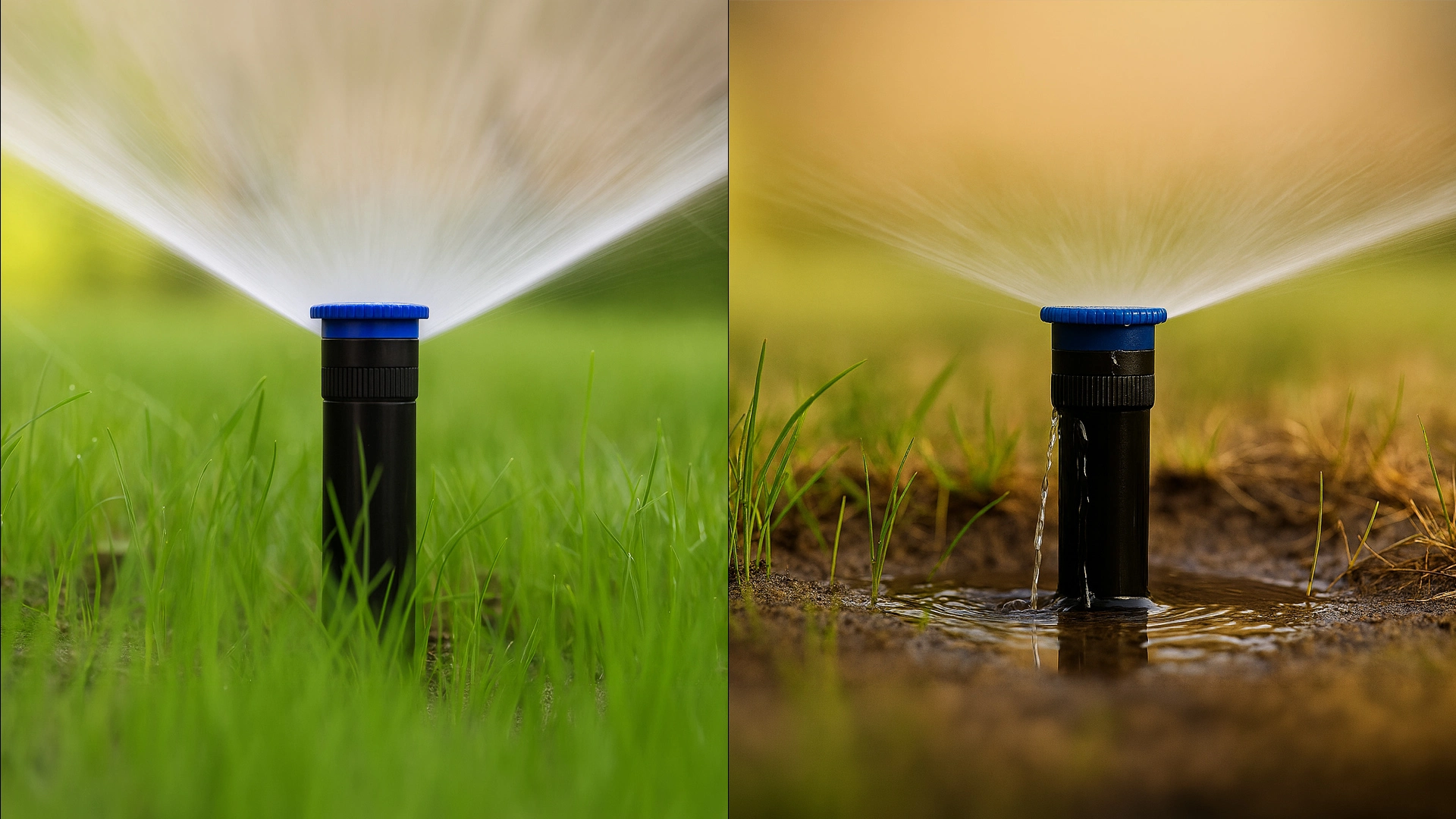
Too much pressure can cause misting and water drift. Too little pressure, on the other hand, reduces sprinkler throw and compromises coverage.
When sizing an irrigation system, it is therefore essential to check:
- available pressure at the source
- friction losses in the pipework
- pressure required by the sprinklers
Only in this way is it possible to ensure that each zone operates within the correct range.
Low DU: when water is not distributed evenly in the system
DU, or distribution uniformity, measures how evenly water is distributed across the soil.
A low DU means that some areas receive too much water while others remain dry. This leads to water waste and an uneven turf surface.
The most common causes are:
- poorly positioned sprinklers
- insufficient overlap
- incorrect pressure
To avoid the problem, it is important to follow the head-to-head coverage rule, so that the spray from each sprinkler reaches the adjacent one, ensuring more uniform water distribution.
It is equally important to correctly select nozzles and spacing based on the type of sprinkler, the available pressure and the geometry of the area to be irrigated, avoiding shadow zones or excessive overlap that can compromise system efficiency.
Irrigation design mistakes are costly
Incorrect irrigation system sizing is far more than a simple technical issue. Over time, it can lead to costly corrective work, higher water and energy consumption than necessary and, above all, a loss of trust on the part of the end user.
A system that does not operate correctly requires more maintenance, more adjustments and more time to manage. For this reason, dedicating time to design and correct irrigation system sizing is always the smartest investment.
Discover the latest innovations
in irrigation systems!